Which Car Is Best in Safety Rating? How to Read the Results and Compare Models
Shoppers often ask which car is best in safety rating, hoping for one model name they can buy and stop worrying about. In practice, crash protection is measured model by model and year by year, by more than one organization, using different tests. A vehicle can score well in one test and less well in another, and a redesign can change its results completely. This guide explains how the two main rating systems in the United States work and what each crash test simulates. It also shows how to compare the results for the cars on your shortlist and which reading mistakes lead buyers to pay for protection they assumed they were getting. By the end you will be able to read a safety report and judge it yourself.
Quick answer: No single car holds the best safety rating for every buyer. Choose the exact model year you want that qualifies for an IIHS TOP SAFETY PICK or TOP SAFETY PICK+ award and has strong NHTSA star results across its frontal, side and rollover tests.
Why no single car wins on safety
Crash testing has no permanent winner. Every result belongs to a specific make, model, body style and model year. Testing organizations also revise their procedures and raise the bar for their awards. A car that did well under older criteria has not necessarily been measured against the tests used now, so comparing a ten-year-old result with a fresh one is like comparing two different exams.
What you need from a car also shapes the answer. Consider a parent who carries children in the back seat every day, a commuter who spends long stretches on fast roads and a teenager buying a first car. Each of them cares about different parts of a crash report. The tests explained below cover frontal impacts, side impacts and the risk of a rollover, and doing well in one area does not guarantee doing well in the others.
It also matters which report you are reading. Most buyers in the United States will see results from two separate bodies. One is an insurance-funded research institute that gives out awards. The other is a government agency that issues star ratings. They run different tests and present results differently, so a car can look excellent in one and only adequate in the other.
So stop hunting for a single name. Decide what type and size of vehicle suits your life. Then look for the models in that group that perform well across every test from both sources. If you already own a car and want to know where it stands, our guide on how safe your car is covers that situation.
The two rating systems you will see
The Insurance Institute for Highway Safety (IIHS) runs its own crash and equipment tests. Vehicles that perform best in its evaluations qualify for TOP SAFETY PICK, which has been awarded since the 2006 model year [1]. A stricter tier, TOP SAFETY PICK+, was inaugurated in 2013 [1] and asks more of a vehicle than the base award does. The institute updates its criteria regularly, so an award describes one model year under that year's rules. It is not a lifetime badge for the nameplate.
The National Highway Traffic Safety Administration (NHTSA) works differently. NHTSA performs three types of crash test and a rollover resistance test, giving vehicles ratings from one to five stars [2]. A window sticker or listing usually shows an overall star figure, with separate star results for frontal, side and rollover underneath it.
The two systems answer slightly different questions. An award tells you a vehicle cleared a defined set of hurdles. A star figure places the vehicle on a graded scale for each test. Reading both gives you a fuller picture than either one alone.
Keep these practical differences in mind:
- Awards are either given or withheld, while stars are graded from one to five.
- Award criteria change between model years, so the same badge can mean different things for different years.
- Star results are split by test, so a high overall figure can hide a weaker individual result.
- Not every model is tested by both bodies, so one source may be missing for a given car.
For a step-by-step walk through looking these results up, see our guide on how to check a car's safety rating.
What the frontal crash tests measure
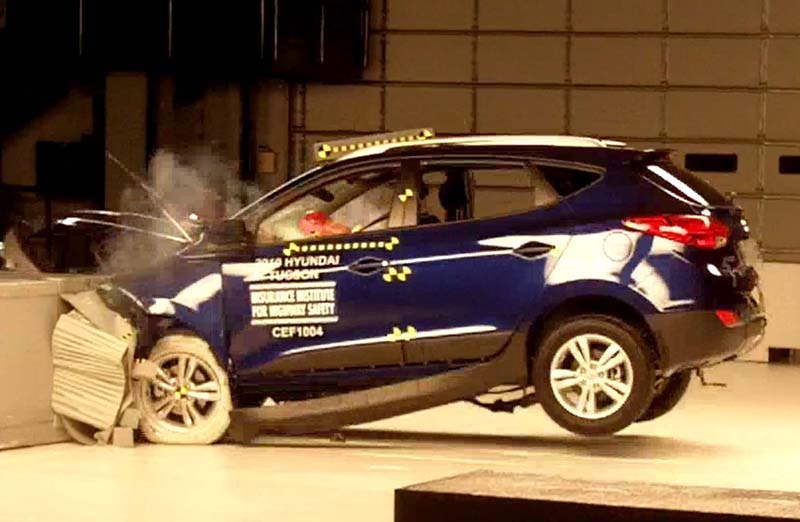
Crash testers model head-on and front-corner impacts in close detail. For frontal tests, vehicles are accelerated into a barrier in either a "moderate overlap" or "small overlap" test [2]. The two differ in how much of the front end meets the barrier. In a moderate overlap test, a large share of the front strikes the barrier, so the main crush structures behind the bumper absorb much of the energy. In a small overlap test, only a narrow strip near one corner hits. That can route the forces around those structures and into the cabin, the front wheel and the footwell.
You may also see a description of an offset test. Here a vehicle is driven into a barrier that crushes only the front of the driver's side, a 50 percent offset [3]. The principle is the same. Real crashes rarely line up perfectly, and a partial impact shows how the body holds up when only half the front takes the hit.
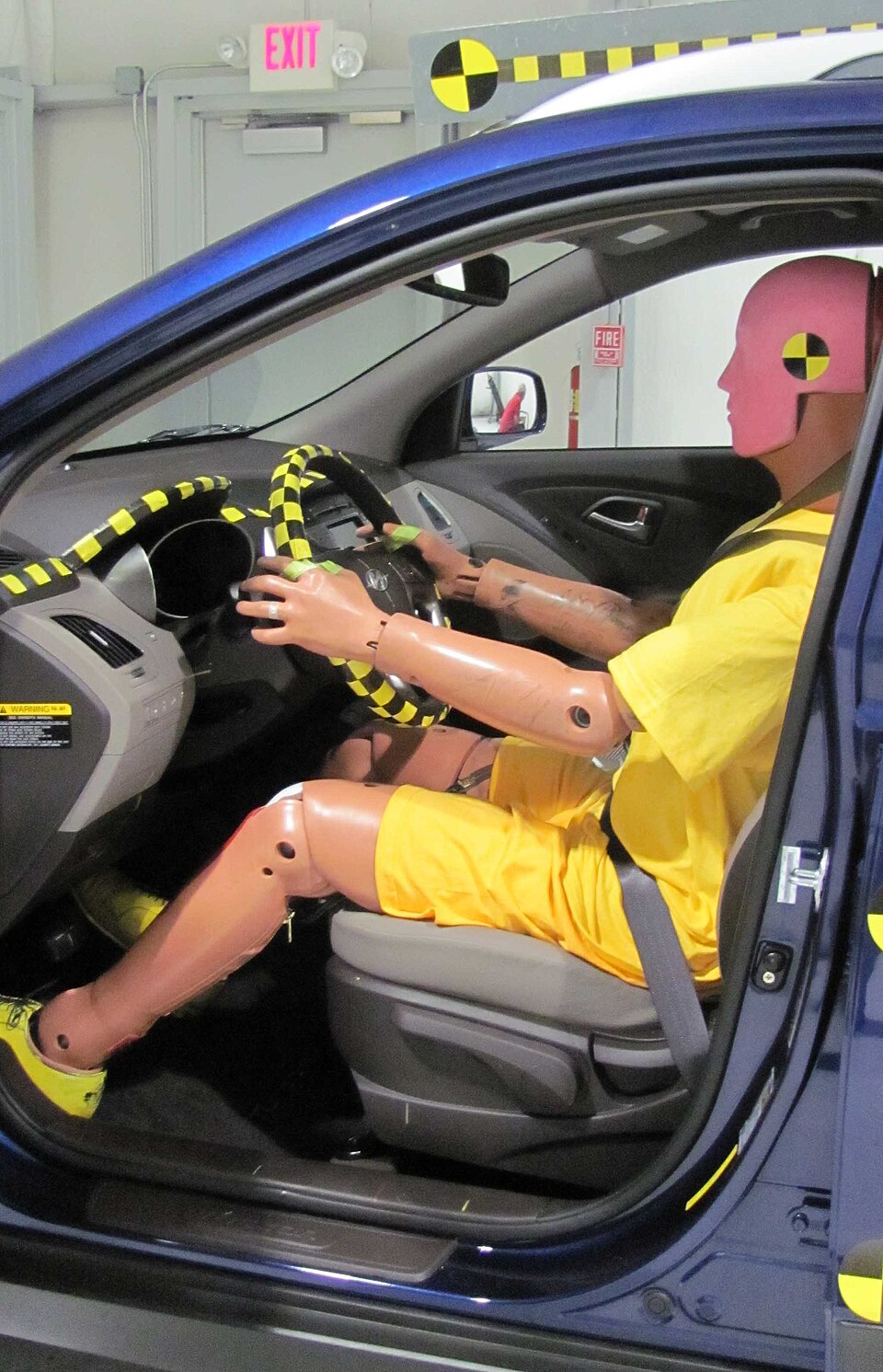
The government's frontal test is run at 35 miles per hour [2], with the vehicle striking a barrier across its front. Instrumented crash dummies sit in the seats, and the dummies are then evaluated for head, neck, chest and leg injuries [3]. Those readings, together with how far the cabin deforms, determine the result on the report.
When you read frontal results, look past the headline figure and check two things:
Side impacts, pole strikes and rollover risk
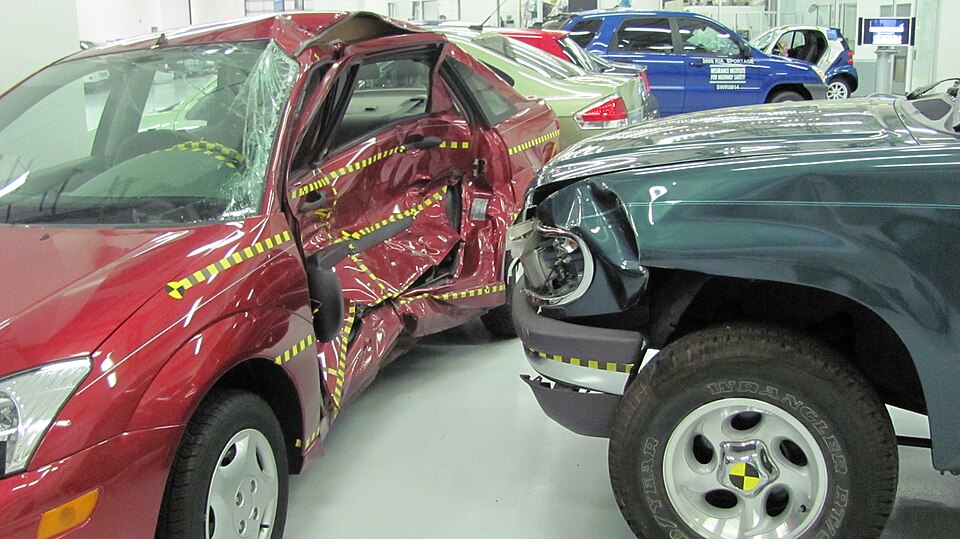
In a side collision there is very little space between the occupant and the striking vehicle, which is why side impacts get their own tests. Side-crash tests involve accelerating a moving barrier into the driver's side and passenger side of vehicles to determine their rating [2]. Testing both sides matters for two reasons. The structure and airbags are not always identical left and right, and passengers are as exposed as the driver.
The government also runs a side-pole crash test, which pulls a 25-centimeter diameter pole at 20 miles per hour into the driver's seating location at a 75-degree angle [2]. Because the pole is narrow, the force lands on a small area of the door, close to where the driver's head and chest sit. That mirrors what happens when a car leaves the road sideways and meets a tree trunk or utility pole. Curtain airbags and a stiff door and pillar structure keep the occupant's head and chest away from the intrusion.
Rollover is handled differently. NHTSA does not crash the car for this part. Its rollover resistance test estimates how likely the vehicle is to tip over, and that result forms part of the one to five star system [2].
When you compare side and rollover results, check these points:
Pin down the exact make, model and year first
Ratings only help if they belong to the car in front of you. A model name alone is not enough. Results are tied to a model year and a body style, and a redesign can change the structure underneath. The same nameplate may also be sold as a sedan and as a hatchback, or with and without certain equipment, and those versions may not share identical results.
For every car on your shortlist, write down the make, the model, the model year and the body style. When you buy from a dealer, these details normally appear on the listing. In a private sale, or for a car you only saw on the street, you may have to work them out. If anything is unclear, ask the seller or a dealer for that make to confirm the details in writing before you rely on any crash result.
Be careful with near-identical cars. Two generations of the same model can look alike from the outside while using a different structure underneath, and a facelift can change the front styling without changing the body behind it. If you cannot tell which generation a car belongs to, treat that as an open question rather than guessing, because the crash results for one generation tell you nothing reliable about the other.
Once you know exactly which vehicle you are dealing with, check whether that model year qualifies for Top Safety Pick or Top Safety Pick+, the two awards the institute gives to vehicles that perform best in its evaluations [1]. Then find the star results from the government's three crash tests and rollover test [2]. Store the results with the vehicle details in your notes so you do not mix up two similar cars later.
Comparing cars for the best safety rating side by side
With the exact vehicles identified, put their results next to each other. A simple table on paper or in a spreadsheet saves you from relying on memory and makes missing results obvious. The table below summarizes the reference points covered in this guide, so you know what each line of a report refers to.
| Reference point | Source | What it tells you |
|---|---|---|
| TOP SAFETY PICK, awarded since the 2006 model year [1] | IIHS | The vehicle performed well enough to qualify for that model year |
| TOP SAFETY PICK+, inaugurated in 2013 [1] | IIHS | The vehicle qualified for the stricter tier |
| Frontal test at 35 miles per hour [2] | NHTSA | Protection in a barrier impact across the front |
| Side-pole crash test with a 25-centimeter diameter pole [2] | NHTSA | Protection at the driver's seating location against a narrow object |
| One to five stars [2] | NHTSA | A graded result covering three crash tests and rollover resistance |
In plain terms, the base IIHS award has been awarded since the 2006 model year [1] and the plus tier was inaugurated in 2013 [1]. The government's frontal test runs at 35 miles per hour [2], its side-pole crash test uses a 25-centimeter diameter pole [2], and its scale runs from one to five stars [2].
Tip: Read each part of the government rating separately instead of stopping at the overall star figure. NHTSA gives vehicles ratings from one to five stars across three crash tests and a rollover resistance test [2], and a single weak result can sit behind a high headline number.
In your own comparison, give each shortlisted car one row. Use columns for model year and whether it qualifies for Top Safety Pick or Top Safety Pick+ [1], frontal results from both overlap tests [2], side barrier results for the driver and passenger sides [2], the side-pole result [2] and the rollover stars [2]. Where dummy readings are published, note any body region among head, neck, chest or leg that is flagged as a concern [3]. Any weak or missing result then stands out at a glance.
Common mistakes when reading safety results
Warning: Paying extra for a used car because the seller says it won a TOP SAFETY PICK award can cost you money if the award went to a different model year. Before the claim affects what you pay, check that the exact model year you are buying qualifies for Top Safety Pick or Top Safety Pick+ [1]. To judge what a car is actually worth regardless of sales talk, see our guide on finding a vehicle's market value.
Other mistakes come up often:
- Treating the overall star figure as the whole story. The government's system combines three crash tests and a rollover test into one to five stars [2], and the differences show up in the breakdown.
- Ignoring the small overlap result. A car can do well in the moderate overlap test and less well in the small overlap version [2].
- Checking only the driver's side. Side-crash testing strikes both the driver side and the passenger side [2], and your passengers sit on the other side.
- Assuming the dummy readings were fine everywhere because the car scored well overall. The dummies are assessed for head, neck, chest and leg injuries [3], and one region can fare worse than the rest.
- Mixing up two similar cars. Keep the make, model and year attached to every result you write down.
Putting a name to a car you spotted
Every step above depends on knowing the exact vehicle. That is easy on a dealer forecourt with the listing in front of you. It is harder when a car catches your eye in traffic or appears in a photo a friend sent. Without the make, model and year, you cannot match the car to the right award or star results.
Car Identifier can help with that first step. Take a photo of a car, or pick one from your photo library, and the app analyzes features such as body style and grille design to return the make, model, year and specifications. You can save the vehicles you are considering to a personal garage so your shortlist stays in one place. Then look up their crash results using the sources and tests described in this guide.
Common questions
- Is a car with five stars always safer than one with four stars?
- Not necessarily. The overall star figure combines several separate results, so a car with a high overall figure can still have one weaker frontal, side or rollover result. Compare the individual results before you decide.
- Does a crash test award carry over to newer or older model years?
- No. An award applies to the model year that earned it, and the criteria are updated over time. A newer or older version of the same model has to earn its own result, even if it looks almost identical.
- Why do the IIHS and NHTSA results for the same car sometimes differ?
- The two organizations run different tests and report their findings in different formats. One gives awards and the other gives star ratings. A car can meet one set of criteria comfortably and score less well under the other, which is why reading both gives a fuller picture.
- Do crash results apply to every version of a model?
- Not always. Body style and some equipment can differ between versions of the same model, and those differences can affect results. Confirm the exact body style and version with the seller or a dealer before you rely on a published result.
- What should I do if a car I like has no published crash results?
- Some models have not been tested by one or both organizations. In that case, ask a qualified mechanic or the manufacturer what structure and airbag equipment the car has, and treat the missing results as a gap in what you know rather than as a good sign.